AI is not a tool. It's a copilot.
Most organizations deploy AI the way they deployed Office 365 in 2014 — install, distribute seats, send a training video. That model is structurally wrong. The copilot frame is the only one that survives contact with reality.
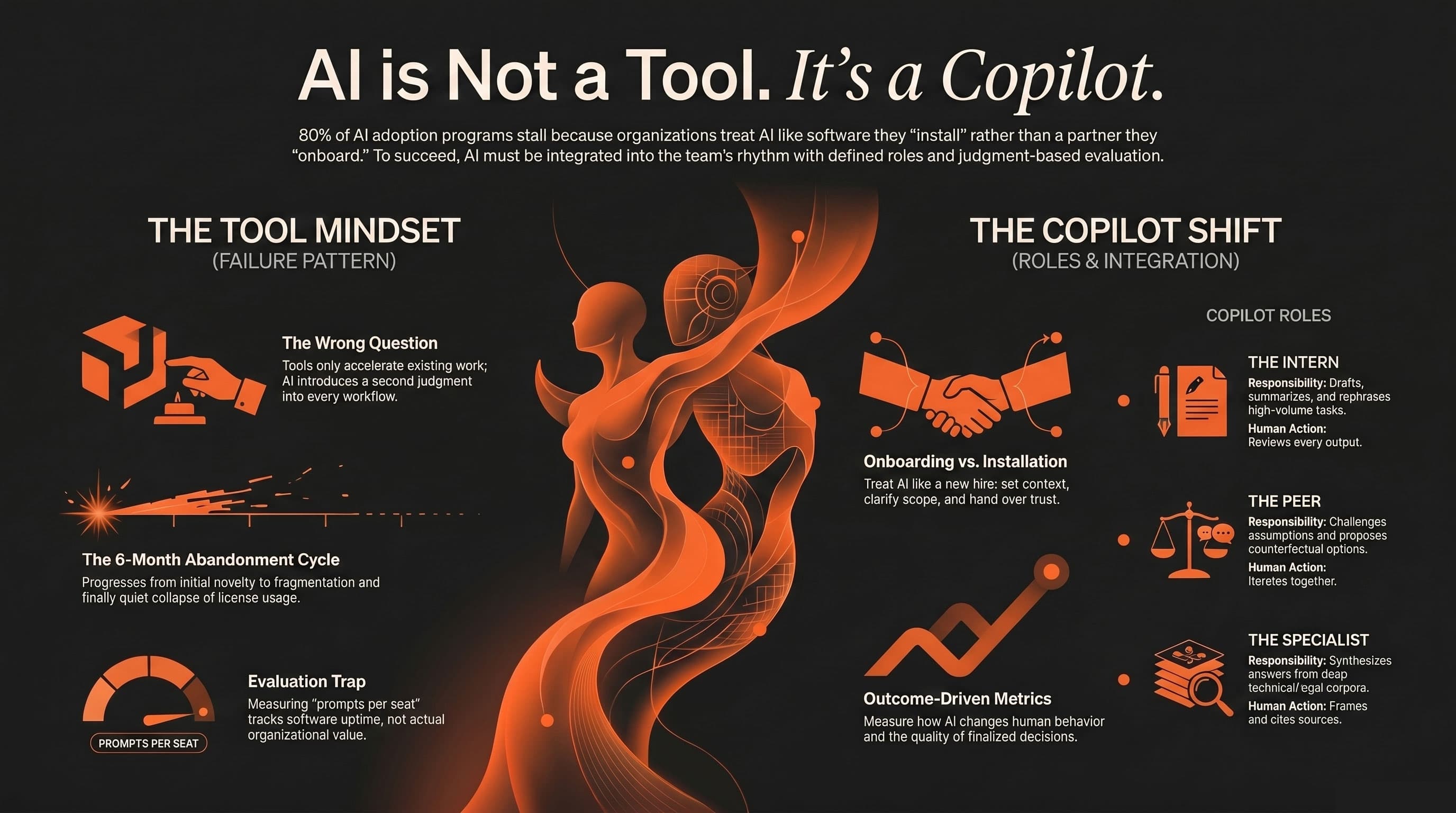
Most organizations deploy AI the way they deployed Office 365 in 2014: install, distribute seats, send a training video, tick the change-management checklist.
That model is structurally wrong. And it's why 80% of AI adoption programs stall at "used occasionally by the engineering team."
The tool mindset
When you treat AI as a tool, you ask the wrong question: does the feature work?
You benchmark output quality. You A/B test prompts. You measure token cost per query. You optimize the instrument.
The instrument is fine. The user is unchanged.
A tool doesn't change how you think — it accelerates what you were already doing. Excel didn't make accountants strategic. It made them faster.
AI is not that. AI shifts who decides and who reviews. It introduces a second judgment into every workflow. Tooling metaphors can't accommodate that shift.
The copilot shift
The only framing that survives contact with reality: AI is a copilot.
A copilot isn't a tool. It's a role. It sits in the cockpit, reads the same instruments, proposes routes, drafts responses, handles the standard phases. The pilot still decides. The pilot still signs off. But the two are in conversation — and the cockpit workload is redistributed.
This reframing has three immediate consequences.
1. You onboard a copilot. You don't install it.
Onboarding a new hire takes weeks. You set context, clarify scope, test judgment, correct early mistakes, hand over trust gradually.
AI deserves the same protocol. Not a one-hour training video — an actual integration into a team's working rhythm, with explicit rules for what it decides alone, what it drafts for human review, and what it flags upward.
Most organizations skip this entirely. They push a license and assume fluency will emerge. It doesn't.
2. You give a copilot a role, not a task.
Tools serve tasks. Colleagues fill roles. Copilots sit in between — but they need role definition, not task lists.
At maars we distinguish three standard copilot roles:
- The intern — drafts, summarizes, rephrases. Low-stakes, high-volume. Human reviews every output.
- The peer — proposes options, challenges assumptions, runs counterfactuals. Mid-stakes. Human and copilot iterate together.
- The specialist — retrieves, computes, synthesizes from deep technical or legal corpora. High-stakes accuracy. Human frames the question, copilot surfaces the answer, both cite the source.
These roles map to different workflows, different prompts, different evaluation criteria. A team that treats every query the same way is treating the copilot the way you'd treat a broken coffee machine.
3. You evaluate a copilot's performance. Not the software's.
Software is measured on uptime, latency, error rate. Copilots are measured on how they changed the humans around them.
- Do your legal team draft faster, or do they draft differently — different argument structure, different thoroughness?
- Do your product managers ship more specs, or do they ship better-qualified specs?
- Does your exec team get better one-page briefs — and do their decisions reflect the new briefing quality?
If adoption metrics look like "prompts per seat per day," you're still measuring the tool. Copilot metrics look like "% of decisions in this workflow that incorporate copilot-surfaced input."
The onboarding failure pattern
Watch what happens in organizations that skip the onboarding — three phases, every time.
Month 1 — Novelty. Everyone tries it. Prompts are shared in Slack. The CEO posts on LinkedIn about the rollout.
Month 3 — Fragmentation. Power users develop private workflows. Everyone else returns to baseline. The tool becomes a specialist's toy, not an organization's asset.
Month 6 — Quiet abandonment. License usage collapses. A task force forms to "rethink the AI strategy." The conversation becomes about vendors again.
What's missing in every case: the work of treating the technology like a hire.
The question that exposes it
Here's a test. Ask any manager in your organization, this week:
"What is this copilot allowed to decide without you?"
If the answer is "I review everything" — you don't have a copilot. You have a slower assistant.
If the answer is "nothing really, I just rephrase its outputs" — you have an expensive autocomplete.
If the answer is specific and confident — "it drafts the initial risk memos, flags regulatory edge cases, I decide the final recommendation" — you have an actual copilot. And a team that has been onboarded.
What changes when you commit
When you stop treating AI as a tool and start treating it as a copilot, three things happen, in sequence:
- Workflows get explicit. You can't hand work to a copilot without first naming what the work actually is. Adoption forces clarity.
- Trust gets structured. You stop asking "is the AI good enough?" and start asking "what's my review protocol?". The question becomes tractable.
- Expertise gets redistributed. Senior judgment moves upstream — framing questions, reviewing synthesis. Junior execution moves horizontally — running more threads in parallel.
That's the real payoff. Not productivity gains — shape changes. The organization does different work, not more of the same.
Where maars comes in
Our AI Acculturation practice exists because this onboarding work doesn't happen on its own. It needs structure, pacing, and someone in the room who has seen the three-month fragmentation pattern fifteen times.
We run it as a 90-day integration: week 1, role definition. Weeks 2–6, team-by-team onboarding with real workflows. Weeks 7–12, evaluation loops and operating rhythm embed.
What you get at the end isn't a deck. It's a set of teams who know what their copilot is allowed to decide.
That's the only adoption metric that matters.